

Healthcare / HealthTech • GDPR-Compliant • European Medical Practice
Confidentiality Notice: This case study discusses process decisions, architecture approach, and timelines only. No product features, user flows, or client-identifying details are disclosed. The client's intellectual property remains fully protected.
| | | |---|---| | Industry | Healthcare / HealthTech | | Regulatory Environment | GDPR (European Union - Germany) | | Platform Type | AI-Powered Patient Communication & Scheduling | | Timeline | 8 months - spec to production | | Tech Stack | React + Node.js + TypeScript | | Key Integration | WhatsApp Automation + AI Chatbot | | Infrastructure | AWS ECS · Docker · Encrypted | | Key Result | 70% reduction in manual appointment handling |
The founder came to us with a validated idea, seed funding, and clear product vision. They had already done their homework, researched the market, mapped their requirements, and picked a tech direction.
Their initial choice: Node.js with a Handlebars template library. It was familiar. It had worked on past projects. It seemed like the fastest path to production.
In the first conversation, before any code was written, before any contract was signed, we looked at the actual requirements: GDPR-compliant patient data handling, dynamic rendering based on consent status, real-time scheduling with WhatsApp integration, and an AI conversation layer that needed a responsive, component-driven frontend.
The recommendation: React for the frontend, Node.js for the backend.
Not because React is "better" in some abstract sense. Because for this specific product, with dynamic rendering requirements, consent-driven UI states, and real-time data flows, React's component architecture was the right fit. The Handlebars template approach would have worked for the first 3 months, then broken when the GDPR rendering requirements hit.
The founder agreed in 5 minutes once we explained why. That single stack decision, made before a line of code was written, saved an estimated 2 months of rework.
This project followed a principle we apply to every healthcare build: the regulatory layer comes first, features come second.
Most developers approach GDPR as a compliance checkbox, something bolted on after the core features are built. For healthcare, that's backwards. GDPR isn't a feature. It's a data model.
We designed the entire data handling layer for GDPR compliance from day one:
The alternative - building features first and adding compliance later - typically costs 3–4 months of rework on a healthcare build. We avoided that entirely because the foundation was right from week one.
The platform architecture has three interconnected layers, each designed for the specific demands of a regulated healthcare environment.
We developed an AI-powered chatbot integrated with WhatsApp as the primary patient communication channel. The chatbot understands patient queries using natural language processing, handles common questions automatically, and manages the full appointment lifecycle, scheduling, rescheduling, cancellation, and instant confirmation.
The critical architectural decision here: building the AI conversation layer to work within GDPR constraints from the start. Every patient interaction follows consent protocols. No conversation data persists outside the compliant data model. The AI layer doesn't operate in a separate data silo, it reads and writes through the same GDPR-compliant data architecture as every other part of the platform.
This is where the React + Node.js decision paid off most visibly. The WhatsApp integration feeds real-time data into the React frontend through the Node.js backend. The component-based architecture means each piece of patient-facing UI respects consent state independently. With a template-based approach, this would have required a complete rendering rethink at the point GDPR requirements became non-negotiable.
At the core sits a custom scheduling system: real-time doctor availability management, conflict-free booking logic, and automatic propagation when appointments change. The scheduling engine connects directly to the AI chatbot, every booking is accurate and immediately reflected across all touchpoints.
The data model was designed for the practice's actual clinical workflow, not adapted from a generic scheduling template. This meant the system handles the real-world exceptions that generic tools handle poorly, overlapping availability rules, last-minute changes, multi-provider coordination, appointment types with different duration and preparation requirements.
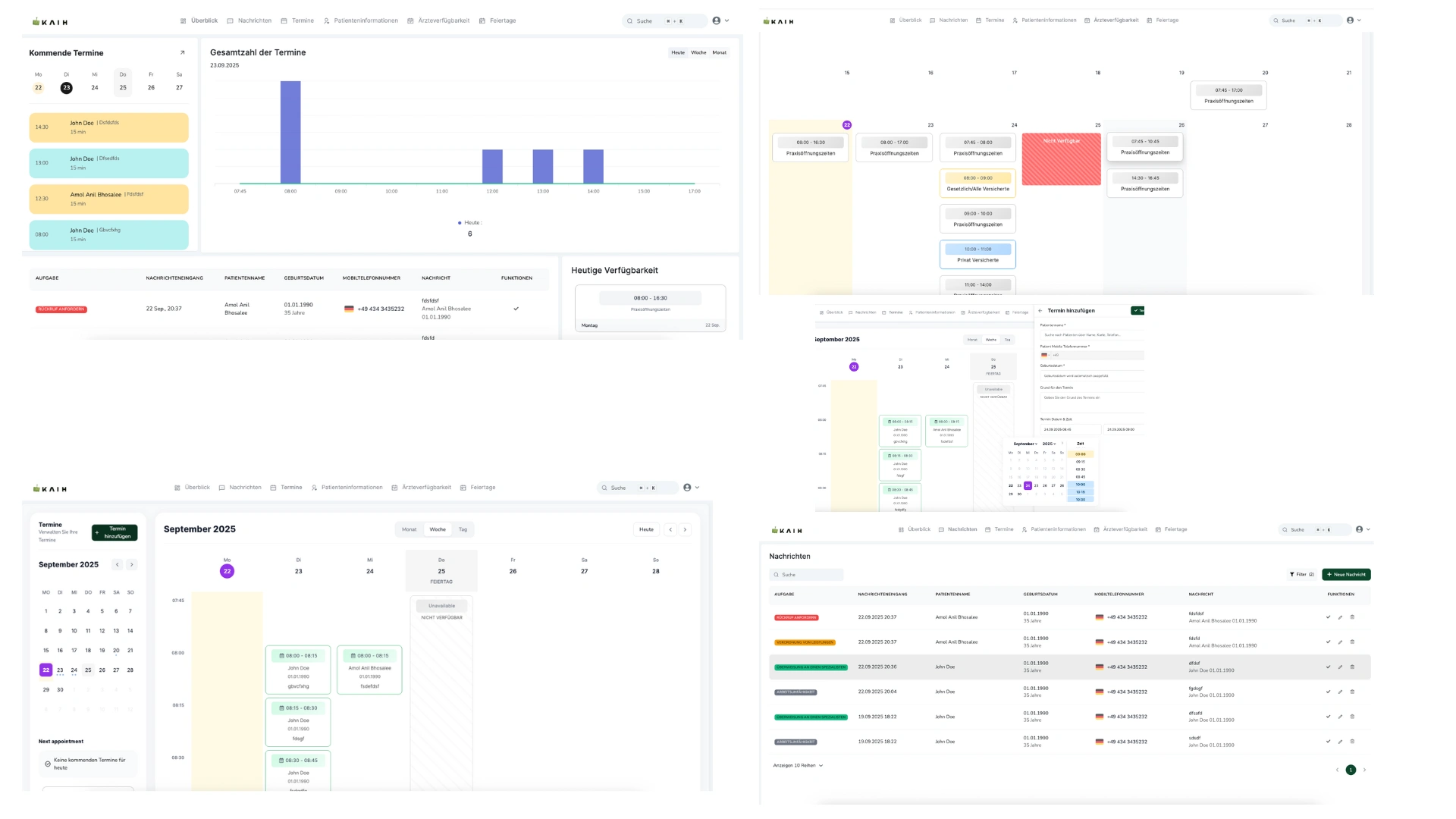
A lightweight internal dashboard gives clinic staff full visibility: appointment management, doctor availability configuration, chatbot conversation monitoring, and manual override capability when edge cases arise. Role-based access control ensures staff see only what they need, another GDPR requirement baked into the architecture, not bolted on.
The platform was deployed on Aws ECS infrastructure - chosen specifically because healthcare data requires full control over where and how sensitive information is stored. No shared hosting. No multi-tenant defaults.
The deployment architecture:
70% reduction in manual appointment handling. The automation layer now processes the majority of bookings that previously required staff intervention, phone calls, callbacks, manual diary entries.
24/7 booking availability. Patients schedule appointments outside office hours through WhatsApp. The phone-call bottleneck, which created peak-hour backlogs and missed appointments, is eliminated.
Faster patient response times. The AI chatbot provides immediate responses where patients previously waited for callbacks during business hours. No more "we'll call you back."
Reduced administrative workload. Clinical staff now spend their time on patient care rather than phone-based scheduling. The practice didn't need to hire additional front-desk staff despite increasing appointment volume.
Scalable foundation. The architecture is designed to expand as a SaaS product serving additional practices, without rebuilding the compliance or data layers. The GDPR-first approach means every new clinic connects to an already-compliant infrastructure.
8 months from first conversation to production
This wasn't because we write faster code. It was because the architecture was right for the regulatory requirements from day one.
The founder had quotes from other developers. Timelines ranged from 6 to 14 months. All "included GDPR compliance." None had specified what that actually meant for the data model.
Here's what those range differences usually mean:
The 6-month quote typically means GDPR as afterthought. Standard database, compliance bolted on. Works until the first regulatory review, then it's a rebuild.
The 14-month quote typically means over-engineered. Enterprise architecture for a startup that needs to ship. Every possible edge case handled before day one. Sounds thorough. Delays launch by half a year.
The 8-month reality meant GDPR in the data model from day one. Minimal but correct. Ships on time. Passes compliance because the foundation is right, not because the budget is big.
The most expensive line in a healthtech proposal is "includes GDPR compliance" with no specification of what that means for the data model.
Looking back, the single most impactful moment in this entire project was the first conversation, before the contract, before the architecture document, before a line of code.
The founder had picked Node.js + Handlebars templates. A reasonable choice based on familiarity. For a simpler product, it would have been fine.
For a GDPR-compliant healthcare platform with dynamic rendering, consent-driven UI states, and real-time WhatsApp integration, it would have cost 2 months of rework when the requirements outgrew the template approach.
The React + Node.js recommendation wasn't about preference. It was about matching the stack to the regulatory and product requirements. One conversation. One question at the right time. Two months saved.
That's the pattern across every build: the decisions that determine success aren't the framework, the language, or the hosting. They're the architecture choices made in the first two weeks that nobody thinks to challenge.
When I discuss past work, I share process decisions, architecture approach, and timelines. Never the product itself. Never the client.
I don't share what clients build. I don't name them. When I reference this project, I talk about how we structured the build, what regulatory decisions mattered, and why the timeline worked.
Your idea stays yours.
I run free 30-minute Build Plan sessions for founders who want a second opinion on their technical architecture before they commit.
You share your product category and the tech you've picked. No product details needed. No IP shared.
You walk away with a 1-page decision doc: what's solid, what's risky, and a realistic timeline. Plus a build plan outline with phases. Two documents. Marked confidential. Yours to keep whether we work together or not.
DM me 'BUILD PLAN'