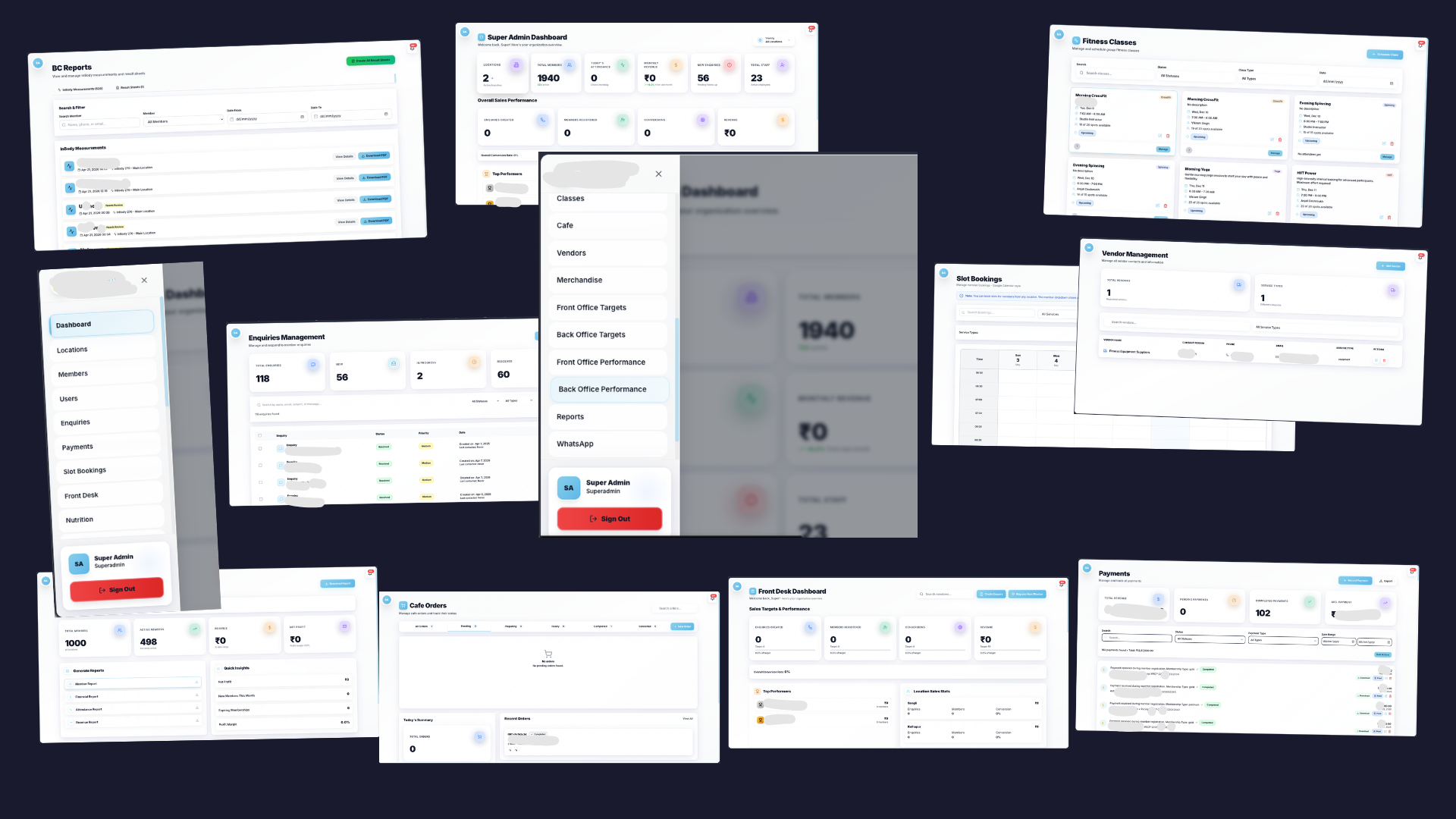
Confidentiality Notice: This case study discusses process decisions, architecture approach, and timelines only. No product features, user flows, or client-identifying details are disclosed. The client's intellectual property remains fully protected.
Industry: Fitness / Premium Gym Chain
Scale: Multiple locations, India
Stack: Next.js, Supabase
Status: Live, stable 3-4 months
The Problem
A fast-growing fitness chain was running on paper forms, Excel sheets, and manual coordination. Operations could not keep up with growth.
The real issues ran deeper than messy admin:
- Paper forms missed medical info, creating safety liabilities
- Cash payments went untracked, eroding team trust and losing 15-20% of potential revenue
- Walk-in enquiries got forgotten, capping conversions at half their potential
- Each location was a black box with no unified management view
- Biometric devices collected attendance data nobody could access, so member churn went invisible
The Approach
Before writing a line of code, the team spent weeks talking to front desk staff, trainers, nutritionists, accountants, and management. The insight: this was not a software problem, it was an architecture problem.
The platform was designed starting with the data model, specifically multi-tenant data isolation across locations and roles. Everything else was built on that foundation.
What Was Built
A full Gym Internal Ops System covering 16 modules across 40+ API routers, 200+ endpoints, 177 admin pages, and 224 mobile features:
- Member management with full lifecycle tracking and InBody body composition sync
- CRM with lead auto-assignment, 24-hour follow-up enforcement, and referral tracking
- Payments with cash shift handover tracking, UPI, card, and EMI support
- Biometric attendance sync every 5 minutes with 3-day absence alerts
- Slot booking for PT, spa, nutrition, physio, and group fitness
- Cafe POS with inventory tracking, waste management, and member account charging
- Reporting engine with revenue, staff performance, and conversion analytics
- 10+ roles with JWT-based access control and location-based data filtering
- WhatsApp automation via WAHA for reminders, bookings, and follow-ups
Results
| Area | Impact |
| ---------------------- | ----------- |
| Data entry time | Down 90% |
| Lead conversion | Up 40% |
| Booking no-shows | Down 60-70% |
| Cafe revenue | Up 25% |
| Revenue leakage | Down 20% |
| Staff admin load | Down 50% |
| Payment reconciliation | 60% faster |
The Principle
The architecture decisions made in week one multi-tenant isolation, role-based access, async background services are the same ones running in production today. The system is built to scale to 50+ locations without touching the foundation.