Sustainability / CleanTech • ISO-Compliant GHG Reporting • Scope 1, 2 & 3
Confidentiality Notice: This case study discusses process decisions, architecture approach, and timelines only. No product features, user flows, or client-identifying details are disclosed. The client's intellectual property remains fully protected.
Project Snapshot
Industry- Sustainability / CleanTech
Compliance Framework- ISO-Compliant GHG Reporting
Platform Type- Carbon Accounting & Energy Management
Timeline- 2+ years (scope expanded with regulatory jurisdictions)
Tech Stack- Node.js · React · TypeScript
Key Integrations- IoT Energy Sensors · ETL Pipelines · AI Analytics
Infrastructure- Self-Managed VPS · Docker · Database Replicas
Recognition- Won Product of the Year in its category
Key Result- 80% faster queries · 60% IoT reliability improvement
The Problem
The founder had evaluated off-the-shelf carbon accounting tools and found them costly, rigid, and architecturally limited. The core issue was not features, it was data.
Existing tools were built for Scope 1 and 2 emissions data, which is structured and predictable. The founder's ambition went further: Scope 3 supply chain data. And Scope 3 breaks everything.
- Different suppliers report in different formats, time periods, and levels of completeness
- Some suppliers provide nothing and require estimation using industry averages
- Most platforms bolt Scope 3 on later, the schema can never handle the variability
- The result is rejected data, manual cleanup on every import, or inaccurate reports
The Approach
The architectural decision was made before writing features: design the data model for Scope 3 complexity from day one, not retrofit it later.
The initial instinct was a standard NoSQL database flexible, fast to prototype. For Scope 1 and 2 that works. But looking at the real requirements ISO-compliant GHG reporting, real-time IoT sensor data, supply chain emissions from dozens of sources NoSQL would have collapsed under the analytical workload within 6 months.
The recommendation: NoSQL for ingestion flexibility, then ETL pipelines moving processed data into a columnar database for analytics and reporting.
One architectural pattern was applied consistently across both Scope 3 supply chain data and IoT sensor data: variable formats, variable frequencies, variable reliability, all normalised through the same flexible ingestion layer.
What Was Built
Phase 1 — Custom Platform and Data Architecture
Migrated fully away from off-the-shelf products. Built a data model designed for the specific analytical and compliance requirements of carbon accounting, not adapted from a generic SaaS template.
Phase 2 — IoT Integration and Real-Time Energy Monitoring
Integrated energy IoT sensors for real-time consumption tracking and system performance monitoring. Built fault detection that catches data quality issues immediately rather than during monthly reporting cycles. Reliability improved by 60%.
Phase 3 — Advanced Analytics and ETL Pipelines
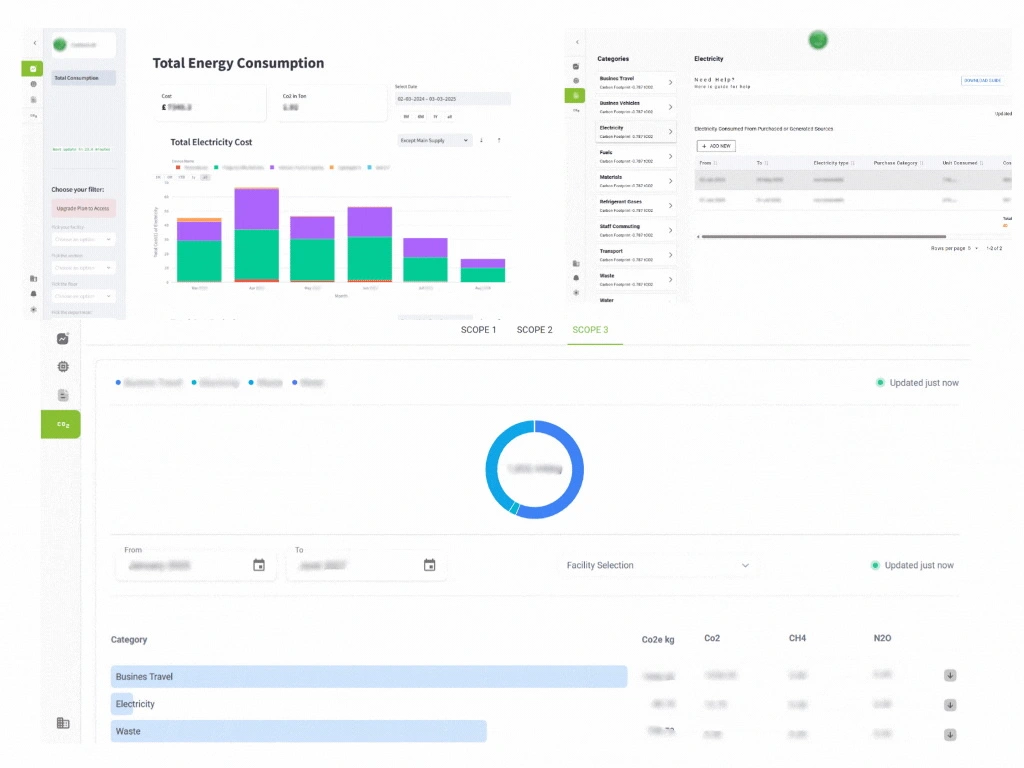
Implemented ETL pipelines moving processed data from NoSQL to a columnar database. ISO-compliant dashboards now return results in seconds. Scope 1, 2, and 3 reports are available at any time, current, accurate, and audit-ready.
Results
| Area | Impact |
|---|---|
| Query performance | 80% faster |
| IoT reliability | 60% improvement |
| Compliance readiness | Full ISO-compliant GHG reporting across all 3 scopes |
| Platform recognition | Product of the Year |
| Licensing costs | Eliminated custom platform costs less than replaced tools |
The Principle
Users do not see the data model. They see that the platform works when others do not. They see that Scope 3 reports are accurate when competitors produce garbage. They see that a new supplier's data integrates in hours, not weeks.
The data model designed in month one is still the data model running in production after 2+ years and multiple jurisdiction expansions. No rebuilds. The foundation held.